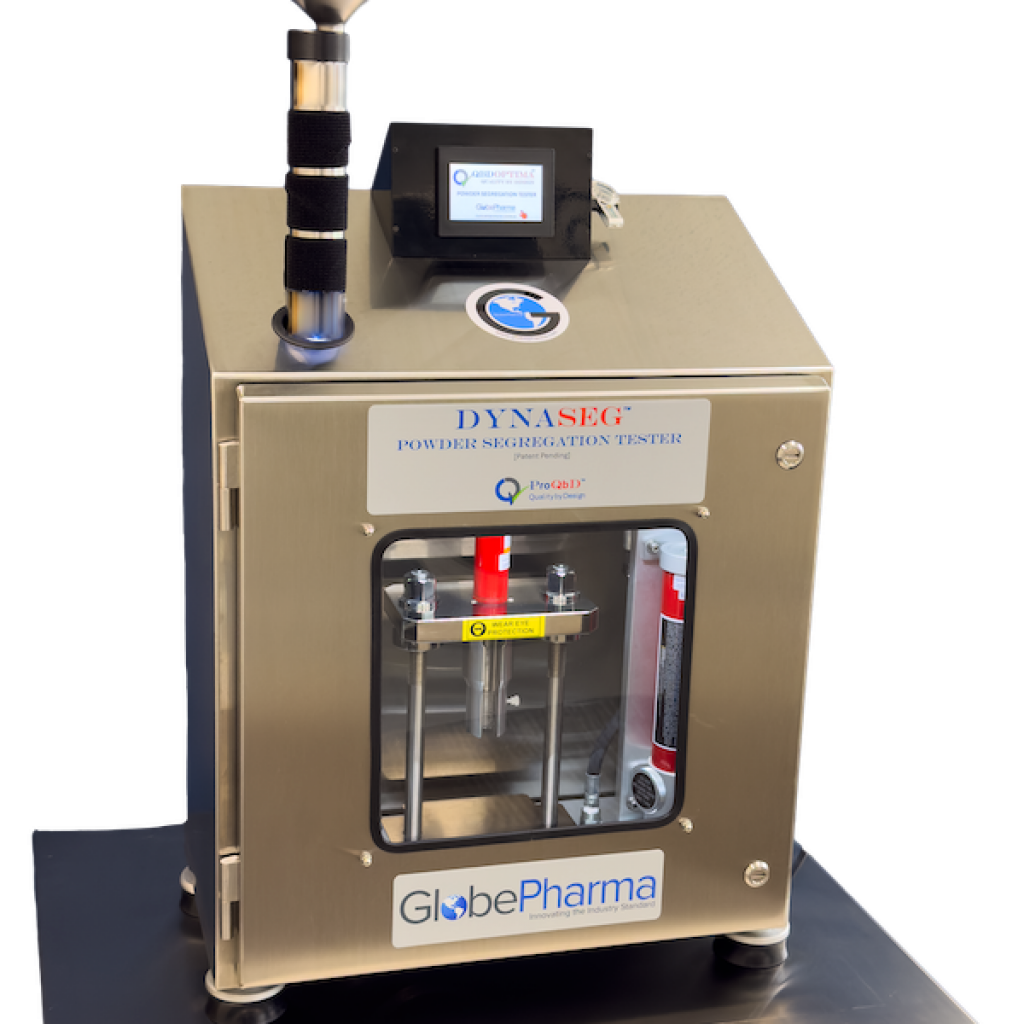
DYNASEG™ (Patent Pending)
Introducing the patent pending DynaSeg™, a breakthrough dynamic powder segregation tester developed to support Quality by Design and eliminate blend and content uniformity failures.
DYNAMIC POWER SEGREGATION TESTER
An innovative apparatus, DYNASEG™ (Patent Pending), and method for segregation testing of powder blends is presented, enabling determination of segregation potential under dynamic stressed conditions. DYNASEG™ empowers pharmaceutical formulation scientists to evaluate, during the formulation development stage, which powder blend formulations are most resistant to segregation during large-scale manufacturing. By identifying robust formulations at the formulation development stage, manufacturers can mitigate content uniformity failures and align with the Quality by Design (QbD) principles for consistent, cGMP compliant production. This apparatus would be especially needed in the development of robust solid formulations of low dose drug products.
Dynamic testing of several powder blends, using low dose acetaminophen as a model drug for low dose directly compressible formulations, revealed that the formulation variables such as particle size, excipient bulk density and drug loading, as well as process parameters such as intensifier type, intensifier speed and blending method strongly influence segregation potential. For instance, micronized acetaminophen consistently produced more robust blends compared to non-micronized powder, while microcrystalline cellulose-rich formulations resisted segregation better than those containing mixtures of microcrystalline cellulose and dicalcium phosphate dihydrate. Similarly, the choice of blending intensifier was critical—SIFT-N-BLEND® technology consistently outperformed high-speed and pin intensifiers, particularly at low drug loading or reduced intensifier speeds.
It is recommended that the solid dosage formulations and the processing parameters be optimized at the formulation development stage itself using the DYNASEG™apparatus to avoid costly content uniformity problems in manufacturing.

Features
- Detect segregation early in development
- Identify robust blends before scale-up
- Reduce risk of FDA citations, batch failures, and recalls
- Align fully with Quality by Design (QbD) principles